Short answer: A B2B buying signal is a public, dated sign that a company needs what you sell right now: a new leader in the team you sell to, a hiring push, a new plant or office, or a complaint about a problem you solve. Prospect companies with a recent signal, open with it, and put those with two or more first.
Key takeaways
- Timing beats volume. A message that opens with something the company did in the last 90 days has a reason to exist.
- The same 8 signals work in every industry; only how they show up changes (a new plant in manufacturing, a SOC 2 announcement in SaaS).
- Specific beats generic. In my first run a specific hiring signal scored 7.9 out of 10 for intent; funding on its own scored 5.5.
- Stack signals. Two or more signals at the same company move it to the top of the list.
- Your own warm signals come first: pricing-page visits, guide downloads and old "not now" replies.
Contents
- What a buying signal is (and is not)
- The 8 buying signals, and the ways to spot each
- What the signals look like in 5 industries
- Specific beats generic
- Stack signals to decide who goes first
- Let an AI team do the searching and checking
- How to turn a signal into a first email
- Rules that keep signal-based prospecting safe
- Sources
- FAQs
Buying signals are how good reps find the companies that are ready now: a new leader, a hiring push, a new plant or office, a vendor they have outgrown. I have prospected this way for years, and it works in any industry. The email opens with something the buyer actually did, not with me.
The catch is time. A person can find these signals, but it is a slow process: reading job boards, LinkedIn posts and funding news, checking that the company and the person are real, then finding and verifying an email, one prospect at a time. So I gave the searching and checking to a team of AI agents, and I spend my time on the conversations. Below are the 8 signals I watch, the ways I spot each one, and what worked and what did not in my first run.
What a buying signal is (and is not)
A buying signal is something a company did, in public, recently, that makes your offer relevant this month. "Opening a new plant in Pune" is a signal. "Is a SaaS company with 50 employees" is not; that is targeting. Targeting tells you who could buy. A signal tells you who might buy now.
Two rules make signals useful:
- It must have a date. I only use signals from the last 90 days, and I keep the link to the evidence for every prospect.
- It must be true. If I cannot tie a person to the company with confidence, I do not email them. A wrong first line does more damage than no first line.
The 8 buying signals, and the ways to spot each
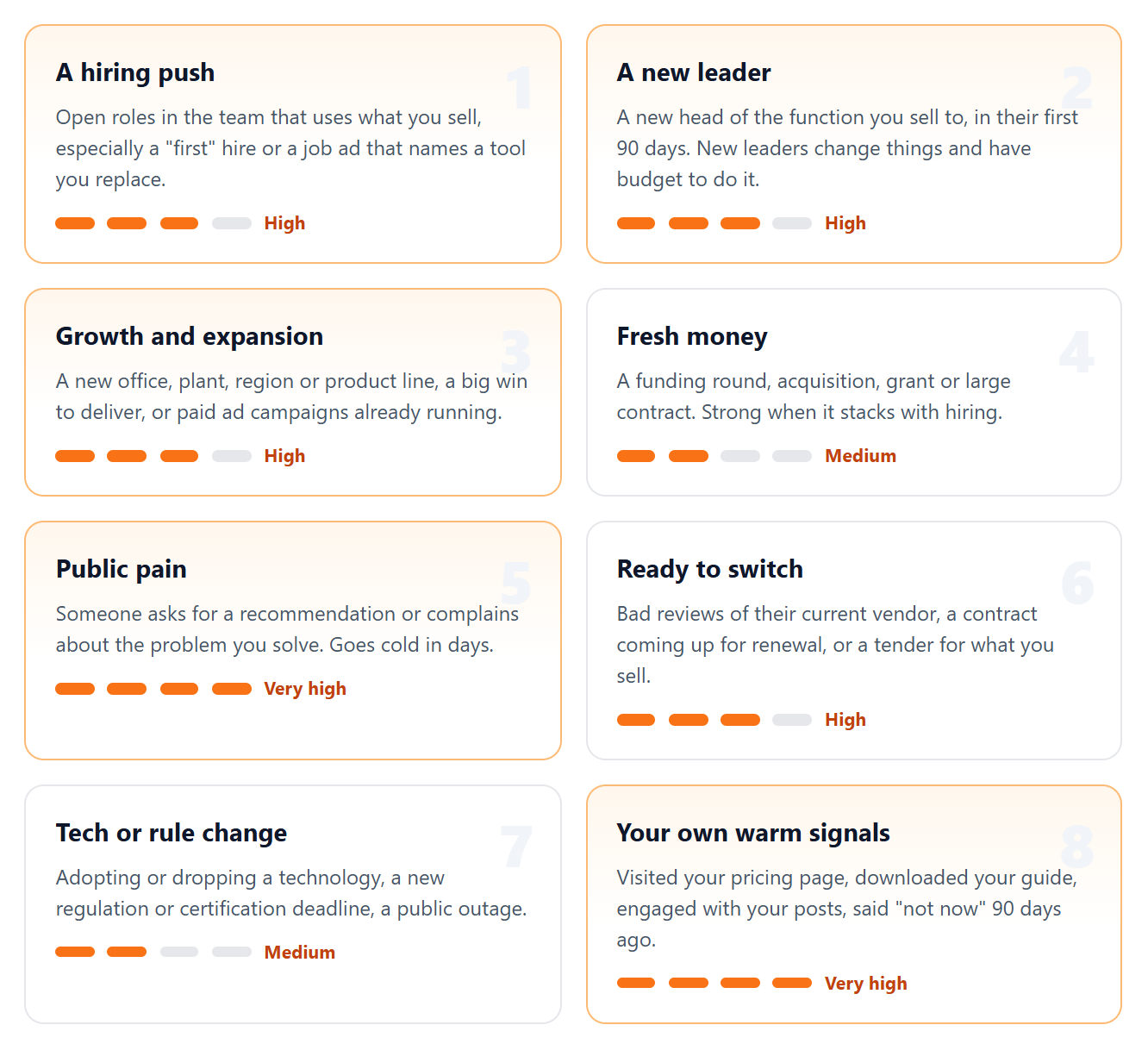
These work in any B2B industry: look for them in the team or function you sell to. The strength column is my rating of intent from years of prospecting this way. Treat it as a starting point; it shifts by industry.
| Signal | How it shows up | Strength |
|---|---|---|
| 1. A hiring push | A "first" hire in the team you sell to A job ad that names a tool or vendor you replace Several roles open in one team, or one role reposted for 45+ days | High |
| 2. A new leader | A new head of the function you sell to, in the last 90 days A new CEO, CFO or COO A new leader posting about plans or their first 90 days | High |
| 3. Growth and expansion | A new office, plant, warehouse or region A new product line or vertical A big customer or contract win to deliver Running B2B ad campaigns (check the LinkedIn Ad Library or Google Ads Transparency Center) | High |
| 4. Fresh money | A funding round in the last 90 days A merger or acquisition A grant, subsidy or government contract | Medium (High with hiring) |
| 5. Public pain | "Can anyone recommend a ..." for what you sell Complaining about the problem you solve Talking about delays, missed targets or a backlog | Very high, but cold in days |
| 6. Ready to switch | Low reviews of their current vendor A tender or RFP for what you sell A job ad to bring the work in-house, or move it out | High |
| 7. Tech or rule change | Adopting or dropping a technology you plug into A new regulation or certification deadline A public outage, recall or security incident | Medium |
| 8. Your own warm signals | Visited your pricing or services page Downloaded your guide or used your free tool Engaged with your posts, or said "not now" 90 days ago | Very high |
The free playbook below adds where to find each one: the job boards, news sources, tender portals and checks I use.
What the signals look like in 5 industries
The 8 signals stay the same; how they show up depends on who your buyers are. A few examples:
| If you sell to | Signals to watch |
|---|---|
| SaaS and tech companies | Series A or B round with hiring plans; job ads naming a tool you replace; a SOC 2 or ISO 27001 announcement; launching in a new country |
| IT services, cloud and consulting buyers | job ads for cloud, ERP or data migration roles; a new CIO or CTO; tenders and RFPs; a merger with systems to combine |
| Manufacturing and industrial | a new plant, line or warehouse; hiring plant, quality or maintenance managers; a new certification or export approval; trade show exhibitor lists |
| HR, staffing and recruiting buyers | 20+ open roles or roles reposted for 45+ days; a new office to staff; a new CHRO or Head of Talent; "doubling the team" in a funding announcement |
| Healthcare and pharma | a new facility, lab or site; a regulatory approval or product launch; hiring regulatory, quality or compliance staff; exhibiting at events such as CPHI |
For deeper industry playbooks, see our guides to lead generation for SaaS companies and lead generation for IT services companies. Selling into a different industry? Comment "Shawn" on my LinkedIn or Instagram post about this playbook and I will send you the signals for your industry, or book 15 minutes.
Specific beats generic
My own first run (I sell outbound services) found 98 verified prospects, each with a dated signal from the last 90 days, and every one was fact-checked twice. It is a 15-day test that is still running, so read the results as direction, not proof. The lesson holds in any industry:
- A specific hiring signal was strongest. A company making its first hire in a team, with a job ad that named a tool, averaged 7.9 out of 10 for intent.
- A new leader in their first 90 days was rated high intent every time.
- A company that had just raised and was entering a new market was close behind.
What did not work: funding on its own (5.5 out of 10), generic job posts (3.7 out of 10), and anonymous reviews, because you cannot reach the person who wrote them.
Stack signals to decide who goes first
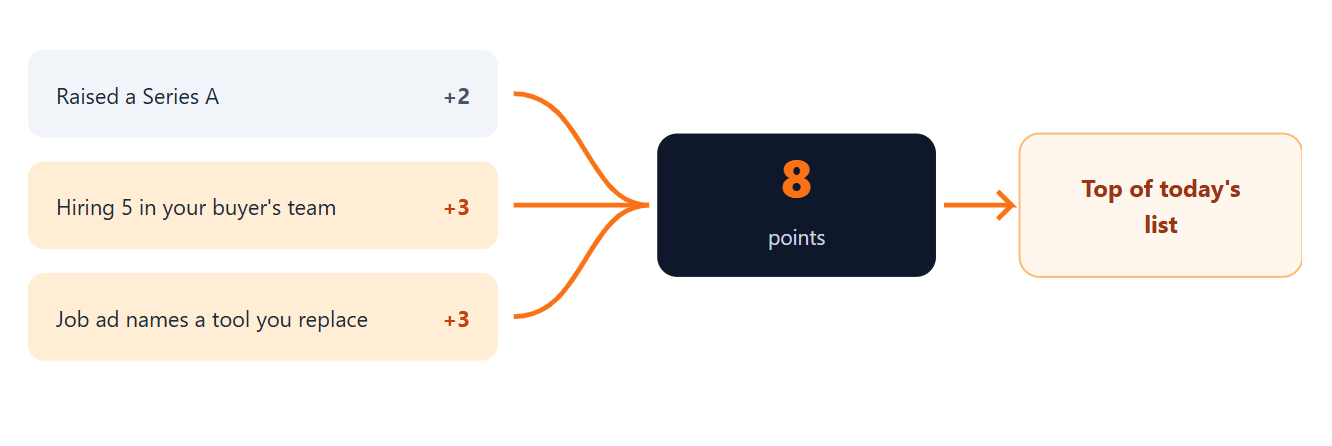
One signal earns a company a place on the list. Two or more put it at the top. A company that has just raised and is hiring in the team you sell to is far more likely to buy than one that has done only one of those.
For more on building the list itself, see our lead generation guides. A simple way to do this: give each signal its strength score (Medium 2, High 3, Very high 4), add the scores per company, and work the list from the top down. Your own warm signals skip the queue entirely; someone who visited your pricing page this week should hear from you before anyone else.
Let an AI team do the searching and checking
Finding signals by hand is where the hours go. I run five research agents built on Claude, one per source (review sites, communities, LinkedIn and job boards, funding news, tool and agency switchers). Three proofreading agents then re-open every piece of evidence: is the date inside 90 days, is the company real, is this the right decision maker, is the hook true? Anything that fails is fixed or dropped, never guessed.
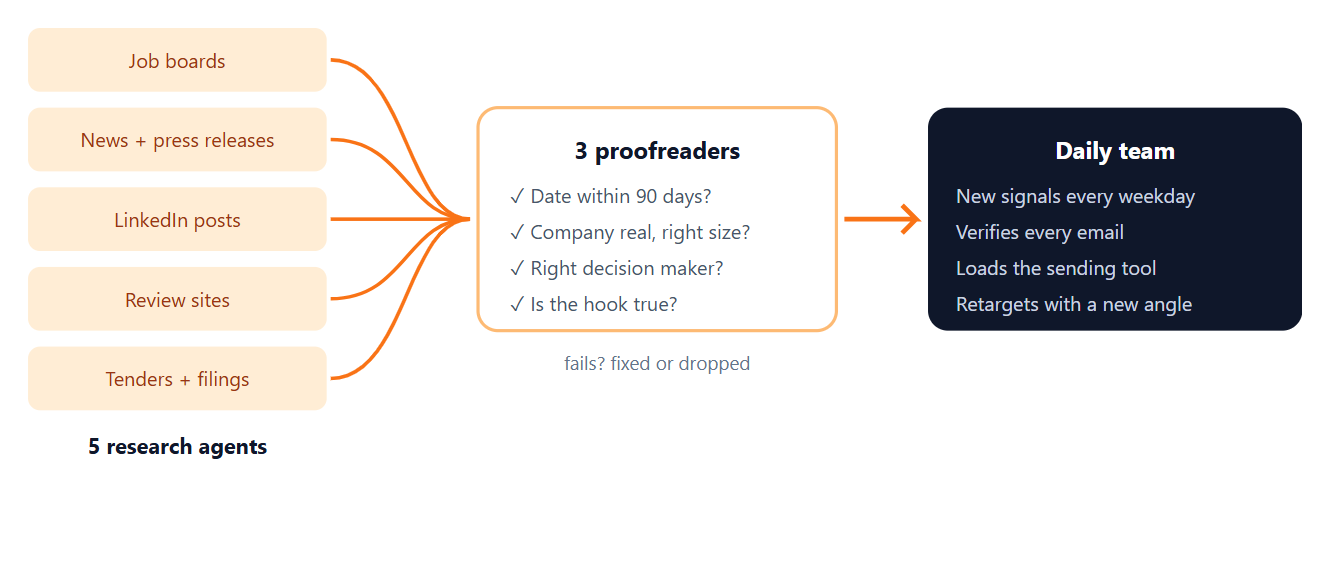
The free playbook includes the three prompts I use to set this up, so you can copy them into Claude today.
How to turn a signal into a first email
The signal is the first line. The rest of the email is short and asks about interest, not for a meeting. Here is the shape I use:
Hi {first_name},

{one line about their signal, e.g. "Saw {company} is opening a new plant in {city}."}

That's usually when {the problem you solve} gets urgent.

{your one-line proof} {how you help}

Worth me sending how other teams handled it?
For subject lines and follow-ups after this first email, use our cold email subject lines and follow-up templates; if a prospect replies with interest, the meeting request templates cover the next step.
Keep it to 50 to 90 words and leave out ROI claims. If you send by email, check your own setup first with our free email DNS checker; our guide to SPF, DKIM and DMARC explains what each record does.
Not sure which signals fit your industry?
Tell me what you sell and who buys it, and I'll suggest the 3 signals I would start with. 15 minutes, no pitch unless you ask.
30-minute call · no obligation
Rules that keep signal-based prospecting safe
- Never guess data. No confident match between person and company, no email.
- Verify every address before sending. About half of the domains I check are "catch-all": they accept any address, so you cannot confirm the person is real.
- Respect local rules. I do not cold email Germany, Austria or Switzerland, and in the UK I only email employees of limited companies. Check the rules for your own markets; see is cold email legal? and the Germany guide. This is not legal advice.
- Protect your sending setup. Signal-based lists are small, so each bounce matters more; warm up new inboxes first (see email warm-up).
- Never contact the same person twice from two places, and never reach out to competitors.
Sources
- B2BXclusive first-run data, October 2026: 98 verified prospects, intent scores rated by our research and proofreading agents. Early results from a 15-day test that is still running.
- Signal list and strength ratings: B2BXclusive, from years of prospecting on these signals.
Want this running for your team?
We find the companies showing buying signals, verify every contact and write the signal-first emails. Book 15 minutes and I'll show you how I'd set it up for you.
30-minute call · no obligation
Your Next Deal Is Already Sending Signals (free playbook)
Get the free PDF: every signal with where to find it, the AI research team I run, three copy-paste prompts and the first email I send.
Frequently asked questions
What is a buying signal in B2B sales?
A public, dated event that suggests a company needs what you sell now, for example a new leader in the team you sell to, a hiring push, an expansion, or a public post asking for recommendations. The date matters: a signal older than about 90 days has usually gone cold.
Which buying signals are the strongest?
Your own warm signals (a pricing-page visit, a guide download) and public pain (someone asking for a recommendation) are the strongest. After those come a new leader in their first 90 days, a specific hiring push in the team you sell to, and growth such as a new office or plant.
Do buying signals work in every industry?
Yes. The 8 signals are the same; how they show up changes. In manufacturing a new plant or certification is a strong signal, in SaaS a funding round with hiring plans or a SOC 2 announcement, in healthcare a new facility or a regulatory approval.
Is funding a good buying signal?
On its own, not very. Funding scored 5.5 out of 10 for intent in my first run. It becomes strong when it is stacked with a hiring or expansion signal, because that shows where the money is going.
How old can a buying signal be?
I use 90 days as the limit. Some signals, such as a public post asking for a recommendation, go cold within days.
Can AI find buying signals for me?
Yes, with checks. I use Claude agents to search public sources by signal family, and separate proofreading agents to re-open every evidence link and confirm the date, the company and the person. Anything that cannot be confirmed is dropped, not guessed.

About the author
Subhendu J Shawn is the founder of B2BXclusive, a B2B outbound sales and lead generation agency, and the creator of Tailr CRM. His experience spans American Express and Amazon, and he has helped 50+ B2B companies build pipeline across the US, Europe, the Middle East and India. All articles by Shawn · Follow on LinkedIn